Be
Yourself? Screw
Yourself!
(...after
all, what if you suck?)
4/10/07
The
essay about Byron
elicited
many compliments, and I’m
sincerely gratified that so many of you out there enjoyed
it — but it also
elicited a bit of confusion and disapproval, mainly from people who
couldn’t
understand why The 1585 would select as its avatar someone who
was so
“phony.”
This reaction intrigued me
so much that I decided
to make “phoniness”
itself — or, rather, baseless accusations of it — the
subject of a new piece.
But this essay
isn’t
going to be about Byron again. For
one thing, his “realness” or lack thereof
was a special case — the man was so conflicted that he had no
idea what about
himself was “real” or “fake,”
and being driven by this uncertainty was a big
part of what made him (and all subsequent artists, whom, as I
explained, Byron
invented) great. For
another thing, the
objections weren’t really about Byron himself
anyway — they were about the idea
that excellence
itself is
supposedly
“fake.” And I don’t
think it is, so
that’s what we’re going to examine now.
In the far-left
sociological cosmology (and also in
the far-right one, although it never gets articulated the same way on
that side
because those people are generally too stupid to articulate their gut
reactions
upwards into coherent principles), no-one is supposed
to be any better than
anyone else at anything. All
forms of
excellence — intellectual, sexual, artistic, or
what-have-you — are inherently
oppressive, and, by virtue of the ad
baculum fallacy, must therefore
be fake. Indeed, a good portion of liberal energy over the
past two decades,
especially within academia, has been expended in efforts to prove the
ultimate
“fakeness” of anything that was ever purported to
be better than anything else
(although, thankfully, the Liberals retreated somewhat from this
position after
the Conservatives called their bluff by channeling the populist
jealousy it
engendered into making a bona fide retard President).
Anything
that ever appeared to be
“good” only
appeared so because it — or its audience — was
“biased” against something else.
Examples abounded
during
the ’90s, but my favorite has to be the removal of the
analogies section from
the Verbal portion of the SAT. It
wasn’t
removed because of racial bias, or gender bias — which are
valid objections when
there are legitimate
grounds to
make them — but because an analysis of the test revealed that
the only way to do
well on the analogies section was… to be
smart. Apparently,
skill at verbal
and conceptual analogies cannot be learned by studying, and so that
section of
the test favored only those kids who were naturally good at it, rather
than the
kids who had studied the most. Around
the same time, the initials SAT
themselves were backronymed from Scholastic
Aptitude Test into Standardized
Achievement Test — aptitude,
after
all, means being good
at something,
whereas achievement
means… uh…
what? Learning how
to look
like you’re good
at something, even
thought you’re not, just because
you could afford tutoring?
What
the hell is the point of a test that measures that?
Oh, right. There isn't one, but
people with money are completely in control of what everyone else does
or doesn't think of as fair. I forgot.
Anyway, I could have dealt with that, if
the people-who-are-good-at-stuff witch
hunt had stopped
there. But
eventually, people realized
that even studying
the most was
unfair — in fact, it was hardly any better than aptitude! After
all,
doesn’t studying
the most
require determination,
which is a form
of aptitude? And
weren’t those pesky smart kids simply the
ones who had started “studying the most” early
in life, as opposed to six weeks before the test?
Those
cheating bastards!
By the early
’00s,
opposition to people who are good at
stuff had dropped all distinction between learning and natural ability,
and
the country just went full Glampers on anyone who
was remarkable for any reason or by any means. This
culminated in the ascendancy of reality shows and George W. Bush, and
the apparent
passage of a law stipulating that all commercials that would once have
featured
a supermodel now had to feature Queen Latifah.
But
the zeitgeist found its quintessential
expression in one of 2002’s
biggest-selling singles — and, not coincidentally, one of the
single most insipid things yet produced by the human race — the
rock-by-numbers
crapfest
“Complicated” by Avril Lavigne.
Curiously
interpreted
as
bearing a “good message” by the
atypically retarded teens of the 21st
Century,
the song — in addition to
sucking, of course — actually has an awful
message, upon which I’ll expound after a painful-but-brief
recap of the
lyrics:
Uh
huh, life's like
this
Uh huh,
uh huh, that's the way it is
Cause
life's like this
Uh huh,
uh huh, that's the way it is
Chill out
what’cha yellin' for?
Lay back
it's all been done before
And if
you could only let it be
you would
see
I like
you the way you are
When
we're drivin' in your car
and
you're talking to me one on one but you become
Somebody
else ’round everyone else
You're
watching your back like you can't relax
You're
tryin' to be cool you look like a fool to me
Tell me
Why you
have to go and make things so complicated?
I see the way you're acting like you're
somebody
else gets me frustrated
Life's
like this you
You fall
and you crawl and you break
and you take what you get and you turn
it into
honesty
and
promise me I'm never gonna find you fake it
no no no
You come
over unannounced
dressed
up like you're somethin' else
where you
are and where it's at you see
you're
making me
laugh out
when you strike your pose
take off
all your preppy clothes
you know
you're not fooling anyone
when you
become
Somebody
else round everyone else
Watching
your back, like you can't relax
Trying to
be cool you look like a fool to me
Tell me
Why you
have to go and make things so complicated?
I see the way you're acting like you're
somebody
else gets me frustrated
Life's
like this you
You fall and you crawl and you
break
and you take what you get and you turn
it into
honesty
promise
me I'm never gonna find you fake it
no no no
(repeat first
verse; repeat chorus; hold
final “no” like you have real bad diarrhea
and make
face accordingly)
Many
thanks for
filling us in on what “life’s
like,” O unremarkable 17-year old. You
will
be the first to whom we turn in all of our lives’ great
crises, provided of
course that they revolve around the insoluble paradox of how pretending
to be a
preppie is unacceptable whereas pretending to be a punk is virtuous,
which they
won’t.
But stripped of
the punks-vs.-preppies stuff, the song reveals itself as
something far more
insidious — it is at its
core an anti-self-actualization
anthem. The
“good message” is that you
should not even bother
trying to
make
yourself something greater than what you are, because it’s
“fake” and “it’s all
been done before,” and because you will incur the wrath of a
teenypunker harpie
who looks like the ghost of the stillborn third Olsen Twin and
“likes you
the way you are,” but whose feelings to that effect are
conditional upon your only
being a poser in the exact same ways that she is a poser, and no others.
In short, it is a
“just-be-yourself” song that
unintentionally reveals the utter emptiness of that sentiment. Maybe
he was trying
to become
himself — isn’t what you want
to be truer
than what you are?
What
you are
is
only an accident. Maybe
he always dreamt of being dapper, but
couldn’t be because his family was poor, so the first thing
he did when he got
older and got a job was buy some swanky threads, and he was all pumped
about
it, and what happens? His
so-called best
friend shits all over him because she’s
threatened (and with good reason: after all, if he keeps
dressing
stylishly
then he might eventually learn who David Bowie is and how to pronounce
his name).
Maybe he’s
being
“fake” when he’s around you,
because you are clearly a bitch. I’m
skeptical of whether “just be yourself”
actually means anything, but I’m pretty sure it
isn’t supposed to mean “just
be me.”
And what pathway is
offered up
as the alternative to this
supposed fakery? What
is it that “life’s
like” again? “You fall and you crawl and you break
/ And you take
what you get and you turn it into
honesty.” What
the fuck is that supposed to mean?
Instead
of trying to improve yourself and
take charge of your life, you just drive around in a car all day with a
bitch
and passively let life happen to you, because that’s the only
way you can be
“honest?” Talk
about herd mentality. Clearly,
someone needs to send Avril a copy
of Thus Spake
Zarathustra — and,
just
for good measure, three copies to the middle-aged corporate hacks who
actually
wrote the fucking song. But
we can see
why she needed the help, because it’s not like soup-to-nuts
I-vi-IV-V isn’t
innovative or anything.
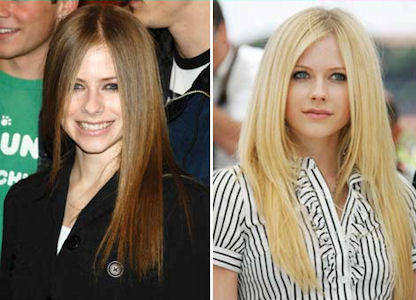
"My
original nose
was just so... phony."
Okay.
We’re
done with
Avril.
But
we’re not done with “just be
yourself.”
From
what I can tell, the
phrase meant something once, long ago — something, I guess,
about not bowing to external
pressure to change things about
yourself that you
don’t want
to
change.
And
that’s cool.
But now
it means “don’t change anything
about
yourself, ever, period,
even if the change would be a positive
one, and even if the desire to change is originating
within you,
because if you
desire to change something about yourself then it must
be because of evil, oppressive, fake
external pressure.”
What if I want to
be
read a lot
of books and become
smarter? Nope. Fake. Keep
on being stupid,
because everyone should
like you the way you are.
What if I want to
work
out and
become all seeeexxxxxy? No
way. Fake. People
shouldn’t
care about that. We’ll
talk more at McDonald’s.
Should I practice
the
guitar
day and night and get really
good at it? Hell,
no. Everything that
takes work is fake.
Here,
just play this fucking
video
game that simulates
playing the
guitar instead. There,
isn’t a video
game about the guitar realer
than
playing a real
guitar? Aren’t fake
things real
and real
things fake?
Isn’t
all achievement a biased,
subjective,
easily-deconstructible illusion? AREN’T I STUPID AND FAT AND NOT
GOOD AT
ANYTHING AND THEREFORE THE MOST “HONEST” PERSON WHO
HAS EVER LIVED?
This may seem like
an
unwarranted reductio
ad absurdum,
but I’m afraid it’s actually a totally
warranted reductio
ad absurdum.
—What
the heck is that supposed to mean, asshole?
What, reductio
ad absurdum? It’s a rhetorical device where you
apply your opponent's warrant to a different claim to highlight the
reasons why it's ridiculous.
—Well,
excuse me, I
guess I didn’t know that because I’m not as smart
as you!
Yes, exactly.
You
do
realize that what you just said was the literal truth, right, and that
it makes
no sense to offer the statement sarcastically as if I were the one at
fault
and not you, right?
—Well,
maybe I would
understand it if you said it in English instead of saying it in Latin
just to
be a dick!
I’m saying
it in
Latin because that’s how you say it.
You’re
the one who’s being a
dick.
—You
should have
stopped the essay and wasted a lot of time explaining what it means in
English.
NO, I
SHOULDN’T
HAVE. YOU SHOULD
HAVE LOOKED IT UP IF
YOU DIDN’T KNOW WHAT IT MEANT. THAT’S
WHAT YOU’RE SUPPOSED TO DO WHEN YOU DON’T KNOW WHAT
SOMETHING MEANS — LOOK IT UP,
INSTEAD OF GETTING MAD AT THE PERSON WHO SAID IT FOR NOT ALTERING HIS
SPEECH TO ACCOMMODATE PEOPLE WHO DON'T KNOW THINGS.
IN
THE TIME IT TOOK YOU TO HAVE IT OUT WITH ME ABOUT THIS, YOU COULD HAVE
JUST GONE TO FUCKING WIKIPEDIA AND LOOKED
IT
UP. YOU ARE ALREADY
SITTING AT A
COMPUTER RIGHT FUCKING NOW — JUST OPEN UP A NEW WINDOW.
WHAT’S
WRONG
WITH YOU?
—OMG
did u here tehy
fond anna nicole’s diery and can u belive sanjaya haznt ben
votid of yet
OMG!!!!!
Prepare yourself,
for
your
world is ending.
Anyway, what I was about
to say before, as usual, I was so rudely interrupted by a person I
made up,
is that you should start paying attention to how people use the word
“only”
— specifically,
how they
insert it into
sentences where it has no place: “He
was only
able to beat me up
because he
knows karate;” “He’s only
smarter
than me because he reads a lot of books;”
“She’s only
considered more attractive than I am because she exercises and
wears sexy clothes”… Okay,
well, these additional
hypothetical complainers may have correctly identified the reasons why
their
rivals are outcompeting them at this or that, but what the fuck does
“only”
have to
do with anything? Are
we to believe that actually making
an effort
to be good at something
counts as cheating?
Isn’t
figuring out what
you have to do to be better
than other people at something and then doing
it pretty much inherently the way
you get
good at something? What’s
“fake”
about that? And if
that’s “fake,”
then what’s “real” — sitting
on your ass all day hoping
you’ll magically
get good at something?
Hell, the “only”
reason we don’t smell bad is because we take showers
regularly — so why don’t all
these people who care so much about being “real”
just stop showering, if
they’re so ardently opposed to artifice?
What’s that?
Because
showering is easy,
and you only
condemn methods of getting good at something as
“fake” when they actually
require effort,
and there are other
people who are willing to put in that effort, and you aren’t?
Oh, okay. I’m
sorry.
Sorry
that this
is where the politics of self-esteem
have gotten us. It’s
not like I’m against feeling good
about yourself — a lot of 1585 is about pride and
self-worth — but I just
feel like self-esteem is supposed to be based
on something. I’m
not going to employ conservative language and say that it’s
“a privilege not a right” or
some shit, but I do
feel as if
it’s
supposed to be based on something. If
you feel good about
yourself despite the
fact that you suck, then something is wrong — and there are a
lot of people
running around these days who feel good about themselves not only despite
the fact that they suck, but because
of the fact that they suck. The
politics of
self-esteem has resulted in
people who genuinely believe that sucking is morally
superior to not sucking.
The
self-esteem-based
reshaping
of education began in the
late ’80s and early ’90s, and was initially focused
specifically on girls. The
idea was that many girls were performing
below potential in school because they lacked confidence as a result of
being
intimidated — directly or indirectly — by boys.
So
educational models
began to move away from
dynamics of true
and false, right
answers and wrong
ones, winning
and losing,
and
towards cooperative interactions that held less truck with objective
ideals,
while the more personal arenas — like
“Health” class — started pushing the idea
that no-one should ever let anyone else convince them that they are not
awesome. After much
of the pioneering girlcentric
self-esteem literature was discredited (most famously, it was
revealed that
feminist researcher Carol Gilligan had studied girls in a vacuum, and
that when boys were studied in the same way, it turned out
that their
self-esteem
was just as low as that of the girls; i.e., high school is a place
where everybody
is intimidated and
silenced by everybody
else, and not just
girls by
boys) we had a
chance to
bring everything back to normal, but we didn’t.
Instead,
we hauled even harder in the direction of
reforming education
so that its primary goal was raising everyone’s self-esteem.
The result was a
generation of people who
feel so entitled to sucking
that nobody can ever tell them that anything
is wrong with them even
when
something is
seriously wrong with
them — a
generation so shocked by the notion that there are ever
situations where Person A is right
and Person B is wrong
that, when this idea is finally
introduced to them for the first
time
in fucking college,
it actually
causes some of them to get up and flee the classroom in tears.
And with this, the
Left
has
supremely fucked itself.
Because,
you see, this newfangled self-esteem
approach to education was only implemented in liberal areas of the
country, and
so the result has been that an entire generation of Liberal kids is
entering
college in complete denial of the fact that anything is ever truer or
better
than anything else — in other words, with no
way to defend themselves against
the Conservative kids who,
when the Blue-State
kids first encounter them in college, are the first people
they’ve ever heard
tell them they’re wrong
about
anything. Luckily,
the Red-State kids
are so
stupid that this still only
results in a tie
most of the time,
but it’s still a big problem. Where
are
tomorrow’s Liberal politicians, activists, and thinkers
supposed to come from
if an entire generation of Liberal kids has been raised to be opposed
on
principle to the ideas that anyone is ever wrong about anything, and
that any
idea is ever better than any other idea, or that anything is
“true” and
anything else “false?” Who
the fuck gets
into politics if they believe that?
Who
the fuck gets into anything
if they believe that? All
they know how to do
is
say that everyone has
“the right to their
opinion” and then go home and play that game where you
pretend to play the
guitar.
Is cooperation
better
than
conflict? In a
perfect society, yes. But
in today’s America,
education ain’t a scene; it’s a god damn arms
race — you can’t dismantle all your
shit unless the other guy does so at the same time.
And
if all the liberal areas of the country
stop teaching their kids how to argue, while all the conservative parts
of the
country are still teaching their kids that screaming others into
submission is
life’s highest calling, then it doesn’t take
someone with a Ph.D. in
developmental psychology to see where this is going to get us in 30
years.
Simply put:
the only
kids who
believe that there is such
a thing
as truth believe a bunch of
shit that is false,
and the kids
who should
believe the shit that is
true
believe that there is no such thing as truth.
I'm not just spinning the wheels of
paranoia here. I've taught at a few different colleges, and
I've seen it happen. In a class where some conservative kids
denied that the My Lai massacre ever happened, the liberal kids didn't
say “yes it did, and this can be proven” — they just
said it
is impossible in principle ever to say whether anything
truly “happened.”
In a class where the conservative kids asserted that the
Biblical account of creation was literally true, the liberal kids
didn't say that evolution was true instead — they just said it
was “mean” to care about which was true, and that no-one
should ever think about it.
Nice going, Liberals. These are
some equipped culture warriors you're training here.
Mean
to care. And
so we enter endgame. If
you care
about an issue, then you probably have an opinion
about it, and if you have an opinion about it, then you must disagree
with others who have different
ones, which means you must believe they’re wrong,
and the more
you care about it, the
more strongly
you believe the
others
are wrong, and therefore you can only be nice
by not caring
about anything. I
can't even count how many students I've had who refused
to write
argumentative papers on the grounds that they “do not care”
— that
“anything
anyone else believes is fine
with”
them. At this stage
in the game, it is
revealed as sadly, bitterly ironic that Carol Gilligan’s
theories were known as
the ethics of
care — as, in
the end,
that is precisely what they do
not allow
people to do. Of
course, the word as
Gilligan and others used it did not mean to
be passionate but rather to be nice,
and was offered up as the alternative to the supposedly boycentric ethics of justice,
which, after all,
were only derived in order to provide an excuse for boys to be mean
and show
off.
Here is their
official
definition:
Ethics
of Care:
a
morality of care rests on the
understanding of relationships as a
response to another in their terms. Focuses on the moral value of being
partial
toward those concrete persons with whom we have special and valuable
relationships, and the moral importance of responding to such persons
as
particular individuals with characteristics that demand a response to
them that
we do not extend to others.
Maybe I missed
something, but
doesn’t that just mean being
selfish and hypocritical? Isn’t
it just
a validation of the animalistic in-group morality that justice and
reason were
derived to contravene and control?
A
reservation of the right to refuse to acknowledge the fact that someone
else’s
khakis and cardigan are no “faker” than your black
wristbands? A
dismantling of the civilized philosophies
that in the long run are what keep women safe, just because in the
short run
you might get girls to raise their hands more often?
The bottom line is,
raising
everyone’s self-esteem across
the board isn’t just ineffective
(numerous recent studies have shown that baselessly high self-esteem
not only
fails to improve academic performance or alleviate bullying, but
probably
actually worsens
academic
performance
and increases
bullying);
it’s dangerous.
If
we could go in with a
scalpel and raise only
the
self-esteem of the kids who deserve
to have theirs raised, then that
would be awesome. But
we can’t. You’re
going to end up raising the
self-esteem of the assholes too, and raising the self-esteem of an
asshole
doesn’t make him stop
being an
asshole — it makes him an even bigger
asshole.
And even though
most
assholes
don’t have low self-esteem to
begin with, assholes are notoriously good at pretending to be whatever
they
need to pretend to be in order not to have to change.
Ever
wonder how the early-’90s first-wave
grunge of good people became the early-’00s third-wave
grunge/nu-metal of
dickheads? Simple. The
dickheads learned to
emulate the low
self-esteem of the people they historically tormented.
They
remained essentially the same people as
Axl Rose and his ilk, heroically overthrown by first-wave grunge, but
realized
that if you act like it’s depressing
to be
Axl Rose, everyone
will leave you
alone. The tuning
stayed in dropped-D,
but the rhetoric slowly changed from “I
am a disaffected kid because everyone is cruel and we’re
destroying the
environment” into
“I
am a disaffected
kid because in school they make me read books and books are for fags.”
And the culture let
this
happen, because of the belief that
the worst thing you could do was fuck with someone’s
self-esteem. So,
that kid is an asshole? Good. At
least he’s
just being himself. That
girl is a pissy hypocrite whose pronouncements
about life are at
best trivial and at worst reduce to insanity?
A+
for being yourself. Whose
idea
was it? The
Liberals. Who
ended up getting fucked by it? The
Liberals.
No-one is making
things complicated.
Things are
complicated.
Life’s like that.
|
