|
The
Other
N-Word
6/16/07
|
“There’s
like a civil
war going on with smart people, and there’s two sides... There’s
smart
people, and there’s nerds… and
nerds have got to go. Every
time smart people try and have a good time,
insecure-ass nerds fuck it up. Can’t
write a bildungsroman no more… Great
American Novel? Great academic deconstruction! Can’t
go to a
movie the first week
it
comes out… Why? ’Cause
nerds are
protesting that the
actress is too thin! I
wish they’d let me join the football team,
because I hate nerds!”
—The
1585,
paraphrasing
Chris Rock
|
I. Introductions
So,
a
lot of you are already
mad, and
that was just the
epigraph. But calm
down, because the
fact is, I’m totally serious here — or, at least,
as totally serious as I get
about anything — and there’s still a long way to go. I’ve
written a
lot of stuff about smart
people over the past few months, but always as defined contra dumb
people, and
never — except for isolated potshots at
“academics” — as defined contra other types
of smart people. But I feel that this
has now become necessary, and so this essay is a bizarrely thorough
examination of
the situation of the “nerd” in contemporary society.
In
the past, I've used
this word casually,
but I'll now attempt to explore the concept more fully.
In
preparation for this, as some of you may
already have noticed, the homepage has been redone to eliminate all
instances
of the term “nerd,” which formerly appeared twice.
What is a nerd? As
is
the case with that other
n-word,
the
term was invented by our oppressors (dumb people) to refer pejoratively
to all
smart people. In
some cases, the usage
is more specific, referring only to those smart people whose smartness
prevents
them from having fun (one theory holds that “nerd”
evolved from “knurd” — drunk
spelled backwards — and originally
referred to people who
never partied, presumably because they were studying instead). Also
like that other
n-word, it can be used
ironically by insiders to refer to themselves and/or other insiders, as
in the
case of t-shirts reading “I Love Nerds,” a message
doubly ironicized by the
popular opinion that smart people are inherently physically
unattractive to
others, or sexually maladroit themselves, or even asexual
(when in many
cases
nothing could be farther from the truth, as we’ll see in
Section V).
I’m
certainly not
implying that the word nerd
is as
objectionable as that other
n-word, or even that it is objectionable at all. Indeed,
throughout most of this essay, I use
it as a term of endearment, and even self-apply it. But I
opened with the reference I did and
the distinction I did because I feel that the concept demands
examination.
This
essay is not about the
word itself — it’s not going to tell you to be
careful how you use it, or
propose rules about who can and can’t say it. What it is going
to do is
encourage smart people — be they current nerds, former nerds,
or those lucky
smart people who were never considered nerds — to think about
how the ideas
behind it are affecting your lives and your place in society as smart
people.
II. Rather
be Dead
than Cool: The
Nerd’s Internalization of His Own
Oppression
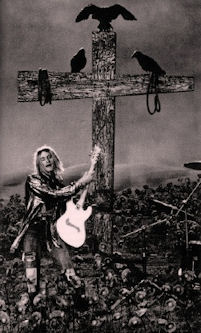
Kurt
Cobain was my whole life
when I was a kid.
When
he came onto the scene, it was honestly
as if angels with flaming swords had descended onto the
nation’s high schools
to drive out the jock bands and bring about our long-promised
kingdom.
Rock
was supposed to be
the peculiar
privilege of the angry dickhead, and Nirvana rocked harder than Guns
‘n’ Roses,
leaving the angry dickheads with nothing. But
then Kurt Cobain blew his head off because he
couldn’t accept the
fact that he was popular. He
had the chance to
redeem several
successive generations of this nation’s youth, leading them
away from all the
things he and we despised about this world, but he gave up that chance
because he
had so much trouble reconciling the fact that people actually liked
him — because being in a
position of
that much influence was so inherently un-nerdly — that
he decided he couldn’t go on living. The
young people of this country might not be such a mess if he had been
around for
the past 13 years — but he wasn’t, because he would rather be dead than
cool (“Stay
Away,” Nevermind).
And
what are the young outcasts
up to now?
Fucking emo
—
which
has merged with straightedge, meaning that many emo kids are purposely
declining to drink or have
sex, in order to show their nerd pride. Excuse
us?
Bullies
try to prevent
you from having fun, so you “get back at” them by deliberately
making yourself
have even less
fun?
That
is exactly the same shit as a marginalized
ethnic-minority member deciding not to go to college because
it’s too
“white.”
If
you have it within yourself to get the
fuck out of your shit situation, then you had best get the fuck
out — and if one
of your fellows tries to give you shit for it, fuck
’em;
they’re not your
friend.
These kids
are embracing the
role that they have been ghettoized into by the cool kids as if it were
their
own idea and they genuinely love being sad all the time and never
having any
fun.
While
you’re at it, why don’t you
just start addressing the captain of the lacrosse team as “massa?”
Just how is this at
all
distinguishable from the Christian
Right, where you’ll find a shitload of brainwashed young
people who genuinely
believe that their peers are only having sex because it's
“the
cool thing to do”
and is “glamorized in the media?” (Here
we see how those who embrace nerddom out of misguided
contrarian-liberal
ideology are actually in much greater danger of being seduced by the
right than
we are.) The simple
fact is, some stuff
is popular for
a reason. For
fuck’s sake,
this is like saying that
people are only drinking water and sleeping because those things are in
fashion
at the moment. Yes,
we have seen movies
and TV shows featuring characters who make a habit of drinking water
and
sleeping, but somehow we doubt the suggestion that we would otherwise
never
have been tempted to do those things ourselves.
Your goal should
not be
showcasing your nerd pride by never
having sex, or fun, or engaging in social competition (and besides,
this
“nerdier than thou” shit is
a social
competition anyway — it’s just a stupid one
that’s playing out on the side stage
instead of on the main stage with the rest of the human race). You
do not give the finger
to the captain of
the lacrosse team by doing this, because this is exactly what he wants
you to
do. Your goal
should be to get stronger
than him, funnier than him, hotter than him, better at the guitar or
whatever
it is you do than him, until he
is
the nerd and his
girlfriend leaves
him for you
(assuming you are
interested in his girlfriend, which you might not be).
You
would not be playing his
game by doing this, but only playing the
game — because there is only one
game, and you either win at it, or you lose.
Do
not allow yourself to believe that by cutting off
your dick and
twirling your hair in the corner like a good little nerd, you are
inventing a
new game. You are simply refusing to play, and that is worse
than
losing.
Please spare us the
line about
how you reject the
“shallowness” of these things, because it is
humanly impossible to “reject” fun
as a matter of principle. Going
to a party once in a while does not
mean that you don’t or can’t read books, and having
sex certainly does not mean
that you don’t read books, since the odds are that those
books were written by
some of the most sensual people in history — assuming that the books
are any
good. If someone
starts an argument with
you based on the position that going to parties does
mean that you don’t read books, beat him in the argument. If
someone starts a fight
with you based on
the position that you should not be
at the party, beat him in the fight.
Does this
constitute giving
oneself over to cruelty? No. It
constitutes a reaction against
cruelty — on the parts of both your oppressors in the present,
and yourself in
the future. People
say that the
most obnoxious and exclusionary people are the cool kids in high
school, but
this is not true. The
most obnoxious and
exclusionary people are nerds who never got over being nerds, once they
have
grown up and created some bullshit thing that they get to exclude
others from,
regardless of whether the people they exclude are former or current
nerds
themselves. This is
because they made no
efforts to crush or escape their own nerdiness while there was still
time, and
so have allowed themselves to be trained to hunger for the ability
to exclude above all things.
If
you
don’t
believe me, try going to a
fetish club sometime (“We are the freaks,
and we accept everybody,
because we
are the complete opposite
of the
cool
kids from high school… but you’re not allowed to
talk to us, because you’re not
wearing jade-green eyeshadow and we don’t like your
shoes”).
And that’s
what
happens when things work out well
for
nerds who can’t let themselves get over being nerds.
What
happens when things
work out badly
is Columbine. And
Virginia Tech. And
a bunch of other
places. And
counting. At this
point, it is both accurate and necessary to
say that “violence
is a problem in the nerd community,” and for the same reason
that violence is a
problem within other minority communities: there is way more
pressure
on
oppressed peoples, both from without and within, to become
stereotypes than there is pressure to confound
those stereotypes — and doing the former is always easier
than doing the latter, and brings with it more instant gratification
and
approval from those of your fellows who desire company in their misery.
“But
wait,” you
may be asking, “how
can you be
talking
about how violence in the nerd community is a problem that needs to be
addressed, when a couple of paragraphs ago you were advocating punching
people?” Good
question. A few
paragraphs ago, we were advocating
punching people who
punch you first,
rather than allowing yourself to believe that, as a nerd,
you don’t have the right
to stand up for yourself, and are supposed
to just give up, go home, put on
shitty music, and cry. Sure,
the latter may
sound
more noble,
but
the problem is, the people who always react that way are the people who
eventually flip their shit and shoot everybody.
It
is simply not human nature to be able to take a
world of shit from
people day-in, day-out, and just laugh (or cry) it off.
Better
to punch one person who has it coming
now than to shoot 50 people who didn’t do anything later.
(And
seriously, just so
we’re clear:
No
guns. Ever. Any
asshole can pull a
trigger.
If you
want to improve both your situation
and yourself, learn karate or some shit. I’m
not some hippie who is against violence
even when it’s necessary, but I am
against bullshit, and
shooting
people is bullshit and strictly for pussies.)
III. How the Nerd
Becomes a Nerdy Camel; and the Nerdy Camel, a Nerdy Lion.
What
nerds must aspire to is
not the rejection of pleasure,
but rather the union of pleasure with intellectual and artistic
superiority, as
dreamt of by Wilde.
Sure,
the dumb may
oppose intelligence out of jealousy, or based on the fact that it
conflicts
with religion, but these bases are not how anti-intellectualism gains
support.
The vast
majority of support for
anti-intellectualism stems from the belief that smart people cannot get
laid — defeat that meme, and you defeat anti-intellectualism.
And
it should not be a
hard meme to defeat,
since it is, after all, a lie — or, rather, several lies
originating from
disparate sources.
The
idea that smart
men can’t fight (and are therefore unmanly and sexually
inadequate) is a lie of
the redneck right; the idea that smart women are ugly used to be a lie
of the
sexist right, but is now equally a lie of the academic-feminist left,
in the
form of its logical equivalent (“hot women are
stupid”).
The fact is, the
vast majority
of the extremely intelligent
women I have known have also been remarkably attractive. This
is a simple
statement, but has become so
hard for most people to comprehend that I'll say it again: the vast majority of the extremely
intelligent women I have known have also been remarkably attractive. Pause
now, and think about
whether this has
also been the case in your own experience.
If
it has, then why
do so many
people believe that the exact opposite
is true?
The misprision
stems from the idea that
anyone who ceases to be a
victim ceases to be morally acceptable — the idea that, even
if you do not rub
your successes in the faces of others, the mere fact of your existence
as a non-victim is hurtful and
oppressive to those who have not yet escaped victimhood themselves. But
the end result of this
reasoning is that no-one
escapes
victimhood, ever.
I've
heard people argue that the concept of intelligence
should be deconstructed out
of existence. I've heard
people argue that all sports
should be proscribed by law. I've
heard people argue, in
required readings
forced on students at
the post-secondary level, that exercise
is immoral based on the fact
that gender
differences are more apparent on
in-shape bodies than they
are on out-of-shape
ones (hey, I went to college in the ’90s — you
don’t even want to know about
half the shit I had to read).
What academia has
been aiming
at for the past two decades or
so is the idea that the special
person — most specifically, the special
boy — does
not exist. Take
Stephen Dedalus, for
example — the quintessential special
boy
of literature. Any
of you who studied
Joyce in school within the last twenty years were probably taught to
interpret
Stephen ironically — that
Stephen is
revealed as a “joke” in Ulysses,
and
even that the point
of Ulysses
is to
retroactively reveal A
Portrait of the Artist to be a parody.
Lies!
Stephen is not
a
joke. Stephen grows
up to be James
Joyce, and this means, quite simply, that your ass is his. Period.
Believe
it or not,
this was fairly obvious to people
in the days before
some assclown decided that “education” means
“let’s make all the boys* feel
like shit.” And,
for the sake of
argument, even if it were
true that
Stephen is a “joke,” it would still
be the case that he grows up to be James Joyce, and so the proper
conclusion
would not be that one should not aspire to be like him, but only that
being
like him is not the final stage.
*(here,
“boys” can be taken to mean both actual boys and any girls who are
both intelligent and attractive.)
Oh, and although it
sucks that
we have to point this out,
the preceding does not
mean that we don’t
take Molly
Bloom seriously — Molly
Bloom is obviously also awesome. You
were probably taught that either
Stephen can be awesome, or
Molly
can,
but this is bullshit, because awesomeness is not a zero-sum game. Stephen
and Molly can both
be
awesome, the same way Lord Byron and
Madonna are both awesome.

Pwnage!
And the
unkindest cut
of all is
that these opinions did not
originate from the inferior and anti-intellectual right. They
originated from the
intellectual left, and their source
was suicidally
misguided
concern
for the self-esteem of the hapless
right-wing
cretins of Dumbfuckistan. And
then we followed our own
suicidal
advice,
while they
watched and laughed.
If you don’t
think that the intelligentsia of
this nation is mired in an abusive relationship with the dumb fucks,
look at it
this way: they lash out at us
because they hate themselves
for being useless, then we
blame ourselves for always
“nagging” them to stop being useless, make
excuses for them, try to make ourselves as useless as they are so they
won’t do
it to us anymore, and then put ourselves into situations that allow
them to do
the same shit to us again.
That is what
“abusive
relationship” means.
“If
we make
ourselves into the
losers that their insecurities demand we be,” our
logic has gone, “then
eventually
they won’t hate us anymore.”
Do you want to know why the
left is losing in this
country? It’s
because we’ve senselessly
burdened ourselves with a moral imperative to be losers. And
that’s what
losers do. They lose.
That’s why
they’re called losers.
At this point, many
of you are
probably ready to bring up
Gandhi, and non-violence, and the whole “eventually the
evildoer will tire of
evil” thing. Only
I’m not arguing with
Gandhi. I think
non-violence is
great. But you know
what non-violence
means? Non-violence
means non-violence;
it
doesn’t mean non-anything. We
must never make the
error of interpreting
non-violence, passive resistance, satyagraha, etc., to mean that you
can’t even say
some shit. See,
this is our problem. “Passive
resistance”
doesn’t mean no
resistance — it means passive
resistance, i.e., don’t
go around
fucking shit up physically.
So
what’s the objection here? Am
I
hitting anybody? Am
I shooting anybody? No
— I am
sitting at a desk, writing
some
shit so that people can read
it and
then talk
about it, so please
stop saying that anyone who does anything
besides hide under their bed and cry all day is “as bad as
Hitler.”
Oh, and as for the
part where I said it was okay to punch
someone if they punch you first? Check
out this good shit:
“Non-violence
does not
admit of running away from danger…Between
violence
and cowardly flight I can only
prefer violence to
cowardice.”
—Mohandas
Gandhi
So,
once and for all, stop
failing to make distinctions between physical violence and
strongly-worded
speech, and stop
failing to make
distinctions between broad military action and personal
self-defense.
Non-violence
is how Dr.
King and the Mahatma
said you’re supposed to respond to institutionalized
government oppression of
your people or an occupying military power in your country — it doesn’t
mean you
can’t turn around and
punch a bully if he sneaks up behind you in the hallway and dumps a
bucket of
piss on your head, for
fuck’s sake!
IV. Why
You Can’t
Even Take a Shit These Days without Someone Comparing You to Hitler
“Godwin’s
Law,” distilled by attorney and author Mike Godwin
in 1990, states that “as
an online
discussion grows longer, the probability of a comparison involving
Nazis or
Hitler approaches one
[the
probability of a certain
event].”
Truer
words have seldom been spoken.
If
you have ever defended a position to the
effect that something is better than, truer than, or preferable to
something
else — especially online — then the odds are that you
have been compared to Hitler
by some dumbass.
Since you are
probably actually
nothing at all like Hitler
(especially if you’re still reading this, since people who
actually are like
Hitler are always incredibly stupid), you may have wondered why this
keeps
happening to you.
The ubiquity of the
reductio
ad Hitlerum is explainable by
the current dominance of a very
few deeply
flawed memes related to opinions and argumentation, three of the most
problematic of which I am about to bust.
Though
the dissemination of all three of the
following concepts is
actually helping Conservatives, all three stances have rapidly been
gaining
currency among Liberals, because at first glance, the ideas seem
liberal. But do not
be fooled: these are actually
conservative memes, disguised as liberal ones.
1.
The
“all
opinions are biased” meme:
Lately,
the first thing Person A does when
Person B disagrees with him is accuse Person B of
“bias,” and this has been
happening so much for so long that the average
person
now believes having
an opinion at all
to
constitute “bias.” But
this is
not the
case. If you begin
the
process of coming to your
opinion with no bias against
any possible conclusion, and use deductive reasoning to arrive at the
best
conclusion possible, then your position is not
“biased.” Yes,
it is still possible
for you to be wrong,
but that is not
the same thing as
“bias.” And
if later generations of people accept the
conclusion based on the
sound deductive process you used (which is not
the same thing as taking
something on
“faith,” because “faith” means
that
you have no
evidence), then those
people are also not “biased,” or failing to be
“open-minded,” because the
legwork has already been done.
2.
The
“blame the
artist” meme: The
1585 has received
many rebukes and caveats from
readers who, even though they understand what I mean and pretty much
agree
with it, still think the overall project is a bad idea, based not on
its own
lack of merit, but instead on the grounds that it “might be
misinterpreted,” — i.e.,
“even if X is true, you should not say X, because someone
might think you mean
Y.” Okay,
true, but the problem with
this is that it makes all utterance impossible, because a fucking crazy
person can always
think you mean something you don’t
mean — that’s what crazy
means. The fuckwad
who shot John Lennon thought that
secret messages in The
Catcher in the Rye
told him to do it — but if your first instinct here is to blame
J.D. Salinger,
you’ve been watching too much cable news.
(Note
that this does not mean that you can’t
ever
criticize any
artist, because some artists actually
are
saying things that deserve
criticism — e.g., criticizing certain rap lyrics for being
sexist and
homophobic is not
based on the idea that someone will “misinterpret”
them as being sexist and
homophobic, because they actually are sexist and homophobic, and thus
interpreting them as such is not misinterpretation.)
3.
The
“ideological
opposition = desire to
proscribe via legislation” meme:
The
difference between fanatics and everybody else is that non-fanatics are
perfectly capable of being “against” something
without necessarily thinking
that the thing should be illegal (e.g., “I choose to
exercise, and therefore am against
not exercising where I
myself
am concerned, and will also encourage
others to exercise and may even make
jokes
about those who don’t,
but nevertheless do
not believe that people who
don’t exercise should go
to jail, and am in fact no closer
to believing this than anyone else”).
But
since only fanatics ever get on TV, because
they’re more
entertaining than non-fanatics, the average person is losing sight of
the fact
that this distinction is even possible.
For
many, having
an
opinion at all
is just “one step closer” to suddenly wanting to
imprison or kill everyone who
disagrees, and therefore it is best not to have opinions. This
is why people will
scream “Free
Speech”
at you even if all you’ve
done is say
that someone is wrong. (See
those balloons
dropping from the
ceiling? It’s
because this is the one
millionth time I’ve had to point out that telling someone
you disagree with
them does not violate their right to Free Speech.)
And because 500
people are
probably still
at work on e-mails
comparing me to Hitler, I will now go on
to explain why this would be baseless.
If
you want to send me e-mails about how you disagree with any number of
things in
this essay, then that would be fine, and I’ll give them all
thoughtful
responses, but I really feel like I should save everyone the trouble
of
simply telling me that I’m “the same as
Hitler.” So
here goes, and I’ll do it step-by-step,
just to make sure everything’s clear:
1. The
reason that so many
people reading this
are so anxious to compare me to Hitler is because you have been
conditioned to
respond to anyone
who ever
says that anything
is “better” than anything
else by going
“You’re the same as
Hitler!” But
this is stupid. For
example,
Martin Luther King said that not
being a racist was “better” than being
a racist, but did this make him a bad
person? No, it made
him a good
person, because he was right
about the fact that not being a
racist is better than being a racist. (Dr. King also said
“The
hottest places in
Hell are reserved for those who, in time of great moral crisis,
maintain their
neutrality” — so much for the alleged superior
liberality of not
having opinions.)
2. The
relevant part is not
whether you say
that X is better
than Y; it is a)
whether you are right,
and b)
what you do,
or encourage others to do,
about it. I am conceding
that is it possible to do
bad
things
as a result of believing
good
things,
e.g. John Brown, who was so opposed to slavery that he killed
slaveholders and
their families (even if you think that slaveholders deserved to die,
you probably don't think that their children did) — but the “bad” part
in this
example is not the fact that John
Brown forcefully
said that slavery
was wrong (because that was a good thing); it is the fact that he killed people
(which is a bad thing),
and I am not killing people or encouraging others to do so.
3. Furthermore,
applying the reductio
ad Hitlerum to all
strongly-worded arguments that X is better than Y is logically
self-negating,
as follows: if it were actually true that anyone who ever
forcefully
asserts
that X is true is “the same as Hitler,” then that
would mean that the people
who opposed
Hitler were
“the same as
Hitler,” because they forcefully asserted that X was true in
cases where X
equals “Hitler is bad and should be opposed,” which
would mean that Hitler was
no worse than the people who opposed him, which would mean that the
givens of
the initial argument vanish, because the givens of the initial argument
were
that Hitler was
worse than the
people
who opposed him, and is therefore a viable comparison by which to prove
that
things are bad.
4. Therefore,
comparisons to
Hitler are only
viable in cases where a)
the things
being asserted are false, or b)
violence
is encouraged. So,
I will save you the
trouble of comparing me to Hitler by keeping everything in the essay
exactly
the way it is, but adding “DON’T FUCKING KILL
PEOPLE.” Thus, I am
not “the same as Hitler.” That
was easy.
5. If
you
still insist on
writing me an e-mail
where you compare me to Hitler, please refrain from arranging it in the
fashion
where you open with “there
was
ANOTHER
person who…”,
and then recap a bunch of
vague stuff about what you think I
said, and then close with “…and
HIS name
was HITLER!!”
…Because doing that
is really, really
stupid. Thanks.
V. Sex
Nerd!
Isn’t
it Nice?
I
have
spoken much of fights,
and of stealing girlfriends,
and
this
may have led some readers to believe that this essay is intended
exclusively
for male
nerds — but this
is not the
case.
We realize
that it is even harder
for female nerds.
We
realize that female
nerds have been conditioned to think “but my popularity is
based solely on my
attractiveness, which I cannot change” — but this
is not the case either.
Just
like
playing the guitar, attractiveness is a skill
that can be learned through diligent study — and
the girls who were “popular” in high school never
ended up studying it, because
nothing ever prompted them to feel like they needed to.
Remember
that people who go to the same high
school have more-or-less all known one another since elementary school,
and
that who is or is not popular in high school is largely a holdover from
this
time — i.e., from the time before everyone’s bodies
had developed.
So,
the alleged “hottest” girls in high
school are largely just coasting on having been the
“prettiest” girls in 5th
grade — and what the fuck is that based on?
It’s
not like when you’re 11,
you talk about other 11-year-olds having
sweet bodies. Being
the
“prettiest” in
5th
grade just means having a decent face, shiny
hair, and parents
who put a lot of time and energy into dressing you. In my
high school, at least, there were several
popular girls who were allegedly popular for being hot, but about whom
I
didn’t see what the big deal was, and lots of girls who weren’t
popular but probably
could have been models — I'd think
“how come everyone isn’t trying to
fuck that
girl?”, but I never said
anything, because I
just assumed
the problem was with me. And I’m
betting
that, if you think back to your high school, you’ll find that
the same thing
was true.
Remember, this is not
an academic-feminist essay arguing that there is no
such thing
as being hot; there is definitely
such a thing as being
hot — all I’m saying is that who people say
they think is hot is not always they same as who they really
think is hot.
The trick is to make
them say it (and not,
as the
academic
feminists would have you believe, to decide that it is stupid to care
about
being hot and give up). Over
the course
of my career as a professional awesome person, I have come to know many
chicks
who are hot for a living — burlesque performers,
alternative/fetish models, and
the like — and they all
say they were nerds in high school.
But
now, being hot is
their job. So
how did this happen? Simple. People
who are not
coasting on
some bullshit thing actually have to try,
and so the chicks who are motivated by not having been the
“pretty” one in 5th
grade are the only ones with the energy to study
hotness — and the chicks who put effort
into becoming
hot by college, or by
their 20s, are the ones who are the hottest at the end of the day, and
who stay
that way. If you
are in the neighborhood of 30 years
old, trust me: every
cool
kid from
your high school looks like shit now.
The first step in
hotness-as-discipline is to reverse the
initial error that most people make.
Someone
who is lamenting the fact that they are not
considered hot is
likely to open with “just because I don’t look
exactly like all those people
who
XYZ…” And
this is the first step in the
wrong direction. Hotness
is not about
looking “the same” as “everybody
else” — prettiness
may be, but hotness is always an invention.
It
is about being notable,
not identical;
an inventor,
not a consumer
(although it may still necessitate buying stuff — this is not
one of those
anti-consumerism essays; I meant “consumer” as a metaphor
there). Hotness
is a
journey into the forest to
wrestle with the deity; prettiness
is
getting an “A” on your quiz in Sunday School.
And
remember that this
essay is not about some
defeatist, “alternative”
definition of attractiveness for losers — it is about the real
definition of attractiveness; even
if you watch those reality
shows where chicks try to become models, the modeling people are always
looking
for the ones who look unique,
and
the
cookie-cutter Maxim-type
girls just
get laughed out the door. The
idea that
sexiness is about looking “the same” as XYZ is
simply a myth, on all levels.
Think of it in
terms of the
“which
one” rule. If
a guy
says “hey, check out that girl in the black pants and
powder-blue tank top,”
the other guy will have to ask “which one?”
No-one
should ever have to
ask “which
one?” about you: no uniforms. The
black-pants/blue-tank
thing is the female
equivalent of guys who wear white ball caps and khaki shorts, and do you
think those
guys are hot? (If
you
do, it’s probably just because they’re confident
— it couldn’t possibly
be about the white ball cap and khaki shorts.)
That being said,
hotness is
also not about weird
for the sake of weird. Weird-for-the-sake-of-weird
can be a uniform
too. Sometimes, one
unique element is all it takes to
pass the “which one”
test. And the fact
that I spoke against conformity
certainly
doesn’t mean
that you should avoid patterning yourself on heroes
— on
the contrary, patterning yourself on a hero is the opposite
of patterning yourself on the
herd. But a patterning
is
not a slavish imitation — you
must ask “what would someone in
this
tradition be doing today?”,
for
you do not do homage to the Great by failing to break new ground.
Will this keep the
herd from
resenting you? No. But
they will at last be resenting you for your greatness, and above all it
is this
that you must not fear. Yes,
white-hats
will say you are weird
for not
looking like someone from The
O.C.,
but should you heed the opinions of the herd, or only those of the
Great? The costume
of a superhero may look odd to
someone dressed normally, but one superhero does not make fun of
another for
not wearing the same costume as himself — just as the herd will
mock all Poets
for the act of poetry, but one Poet does not fault another for not
writing in
the same style as himself. (Okay, fine, contemporary Poets
talk shit
about one
another all the fucking time for this reason — but this is
because 95% of them
are nerds who never got over being nerds, which is the whole problem
here, and
besides, those aren’t the ones people will still know about in
100 years.)
You have been
taught that
someone who looks
at you has power
over you, but this too is a lie. Meaning
emanates outward
from the objet
d’art,
just as, in a theater, it is the movie that has power over the
audience, and
not the other way around. Those
who
interpret you only control you if you choose to project the idea that
they do
(as indeed, many opt to do). You
have
been taught that sexual attractiveness is consubstantial with
conformity and
submission; with the simple fact of appearing willing
— and
this may be true of prettiness,
but not of hotness, which
is Art. And
Art is not willing;
Art only wills.
But have I now
departed from
the domain of the nerd? Not
at all. One of the
accepted definitions of nerd
is someone who puts a lot of effort into obsessively studying some
really
specific thing, right? And
the original
definition of cool
involved not
getting excited about things, i.e., not
trying, right? Well,
there you have
it. The
true
hottest people are not the
ones who lucked into unremarkable elementary-school
prettiness — the true hottest
people are the sex
nerds. Madonna
did not have the
face or body of a
supermodel growing up, but she made
herself the sexiest woman in
the world
by studying
sexiness the same way a
doctor studies medicine (will some university please give her an
honorary
doctorate, already? She
really should be Dr.
Madonna). In
short, Madonna is a sex
nerd, the same way a guy who
speaks Klingon is a Star Trek
nerd.
Just take the
following couplet
from Alexander Pope:
“True
ease in writing
comes from art, not chance—
As
those move
easiest who have
learnt to dance.”
…and replace the
word “writing” with “hotness.” The
simple fact is,
constructed,
“I-am-trained-in-the-ancient-arts-of-hotness”
hotness is way
hotter than
accidental,
“Hi-remember-me-I’m-the-pretty-girl-from-5th-grade”
prettiness.
Examples
of the former include Dita von
Teese, and examples of the latter include Jessica Simpson — and
if you would
rather fuck (or be, or be and
fuck)
Jessica Simpson than Dita von Teese, you’re probably not
reading this
essay.
In fact, if
you would rather fuck
Jessica Simpson than Dita von Teese, you probably don’t read
much of anything.

Dr.
Madonna:
Art, Not Chance
Oh,
and plus: the
chicks who
studied hotness and
everything? Those
are totally the ones
who do anal. The
chicks who were popular
in high school are still all like “Eww, that’s not normal.” I also have it on
the authority of several chicks that the guys
who were popular in high school are terrible in bed as well.
VI. The
Negative
Consequences of Retreat into the Metaphor,
or,
Please, Please
Stop
Dressing Up as Elves and
Shit
All
of
the preceding is really
just a simple combination of
Nietzsche and Freud — if the people who become
themselves, and thereby transform humanity, are those with the will to
power,
and those with the will to power are those who are motivated
into it by formative experiences in their childhoods,
then it is no great leap to draw correlations between nerds and the
übermensch
(once again, we remind all dipshits that the destruction involved in
the coming
of the übermensch is progressive self-destruction,
from camel to lion and from lion to child, which is both liberal
and positive,
and
that influence over others comes naturally
as the result of having accomplished this, and that the process has nothing
to do with deciding
you are übermensch and forcing
others to do anything).
But
one must do
so carefully, for two reasons (actually, it’s just one
two-part reason):
1. We
cannot allow
this to become one of those stupid “nerds have
superpowers” things, à la Star
Wars, Harry Potter, and an infinite number of other
retreat-from-reality
templates. This
essay is about
real life, not an
excuse to
fucking dress up as elves and rent a field in which to duel with
fiberglass
broadswords while singing songs from Monty Python movies. That
shit is the nerd
equivalent of acting
like Stepin Fetchit.
2. It
must be
remembered that, along the lines of the logical “all lions
are cats, but not
all cats are lions” template, what we argue is that all
übermensch are nerds,
but not all nerds are übermensch, i.e., the mere fact that
everyone hates you
does not mean that you are special, because it is entirely possible
that
everyone hates you because you are
in
fact a fucking loser (cf. activities delineated in #1).
This
essay is a beginning, not an
end — i.e.,
it is an exhortation to make something of yourself, not an excuse to
lean back
in your chair and feel justified by the mere virtue of having read it. The
concept of nerd
can be an
ironic term of endearment,
but it is first and
foremost an identity that must be rejected, crushed, and escaped from
(once again, like the other
n-word). Those
who
are nerds in the
positive sense run towards
real
life,
and those who are nerds in the negative sense run away
from it.
But we must thank
the sci-fi
and RPG nerds, because it is
in the act of contemplating them that we hit upon something extremely
important.
What
these people allow us to realize is that we
as a culture — and
smart people especially — subconsciously miss
the concept of the dynamic figure with special powers who changes the
world. We
aren’t allowed to believe that
about people (least of all ourselves) in real
life anymore, because Nazism ruined it — anyone who believes
that they are a
superior individual with special powers these days is just going to get
compared to Hitler, regardless of whether they’re a bad
person or a good person
(see Section IV). And
this is why so
many nerds — people with better than-average abilities in some
capacity or other,
and an outside-the-box way of looking at life — have taken to
retreating into
fantasy worlds where this metaphor is still allowed: Star
Wars, Harry
Potter,
Lord of the Rings, etc. If
you channel
your energy into dressing up as a fucking Jedi and going to
conventions, people
will call you a loser, but not a Nazi.
But
if you drop the charade and try to be the real-life
equivalent of a
Jedi — an artist, or a philosophical or social
leader — you will be rebuked for it.
But this, as I’ve
been arguing all along, is not only
unfair, but counterproductive. And
as a
show of good faith, I will now demonstrate this with an
unfuckingbelievably
nerdy analogy:
If someone were
only ever made
aware of the existence of the
Dark Side of the Force, as practiced by Sith — perhaps because
that’s the only
Force-related stuff that ever gets reported on the news where they
live, or the
only kind that gets talked about in school — then this person
would be under the
impression that the entire
Force
itself was a bad thing and could only lead to trouble.
They
would, in other words, be unaware
that the Force could also be
used for good,
when this is in fact
the normal
way to use it, and the
path taken by the majority
of
Force-adepts. So,
taking up the
principle that “the Force should not be learned or practiced,
ever” would be a
well-intentioned but shitty idea, since a)
the Sith will not listen to you, so your dictum will have zero effect
on the
number of Sith, and b)
you will be
fucking your society out of the only people who could have defeated the
Sith,
i.e. Light-Side Jedi, since they are good
people who will
listen if they grow
up in a society where other good people all say that the Force is a bad
thing.
Whether you want to
look at it
in terms of the Force in Star
Wars, wizardry in Harry Potter, or the Mutant-X gene in the X-Men
universe, the
dynamic is always the same: some individuals who have the
power use it
for
good, and others for evil, but the power itself is neither good nor
evil. The rational
conclusion is not that the power
should not be used, but rather that it should be used for good. (The
most notable
exception, of course, would
be the Ring of Power in Lord of the Rings, which is wrong to use in all
cases — but remember that there are also a number of other
magic rings that are good,
so this analogy only seems disruptive at first, because we are here
dealing
with a finite number of individual specific objects rather than a
diffuse
“power;” in actuality, however, the rings dynamic
is no different from pointing
out that there are certain Force-powers in Star Wars that can only be
used by
Dark Jedi — I am happy to concede this, and submit that the
real-life distaff
of these powers would be… um… making
up statistics or deliberately quoting
people out of context or something.
You
know, the stuff Ann Coulter does.)
Yes, every serial
killer was
transforming the pain of a
shitty childhood into the belief that he was superhuman — but
so was every great
author. We have
thrown the baby out with
the bathwater by demonizing all forms of exultant
self-mythologizing, because
throughout history, many good
people have achieved positive
things via the same process. When
we hear
the music of Wagner today, we are all but incapable of associating it
with
anything but Nazism — but although, for example, the
incomparably gorgeous
overture from Tannhäuser
was a
favorite of Hitler’s, it was also a favorite of Oscar
Wilde’s (yes, I know I'm making a habit of using the “Oscar Wilde
Forcefield,” but just run with it
this time, and I promise I’ll try to cut down).
We
interpret its strains
almost a priori
as glorifying war,
but it actually glorifies only transcendence,
becoming, thanatos
— i.e.,
it glorifies glory
itself — and there
are many permutations of this besides war.
The
actual plot of the opera concerns a traveling
poet who becomes a
supreme artist via orgiastic communion with Venus — but, I
suppose, even with
this information we can still see why the modern left balks at the
sensations
it engenders, since contemporary academics are at least as opposed to hot girls
and to the
concept of talent as an objectively quantifiable power
as
they
are to war.
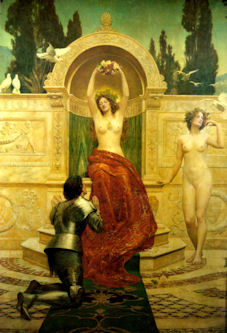
In
the
Venusberg
Tannhäuser,
by John Collier (1850-1934)
And it’s
not
even
necessary to resort to opera in order to
demonstrate this. How
many of you have
been getting psyched up in your cars over the last few months whenever
My
Chemical Romance’s post-punk masterpiece “The Black
Parade” comes on? Well,
doesn’t that song occupy the same
emotional terrain, and doesn’t its narrative involve a
“savior” figure, destined
to crush some dark opposing threat, armed with the guidance of a
traditional,
all-encompassing father-concept? Clearly,
if that song had been around back in the day, Hitler would have been
all over
that shit — but that doesn’t make it a bad song,
because good people like it
too. It’s
just that good people imagine
something good
when they’re listening to it, instead of a bunch of crazy
evil bullshit. (Plus,
sonically the song is an homage to
Queen, which brings us back to the descent of this emotion through
Wilde.)
VII.
Why
Nerds Do Not
Count as Girls
The
problem with models of
the oppression dialectic
post-P.C. is that they’re all modeled on (the bad kind of)
feminism.
In fact,
the entirety of P.C. has really been
an expanded
feminism
based on the
presupposition that gay men, ethnic minorities, etc., count
as girls,
the various
oppressors count
as boys, and
that the remedy
for
oppression involves convincing
your oppressors to stop,
rather than a)
fucking making
them
stop, or better still b)
becoming better
than them at whatever it is they’re oppressing you with.
The
P.C. mindset is often
expanded even
further, to the point where not only all oppressed
people, but all good
people count
as girls.
I'm reminded of a method I encountered of
delineating “lesbian space” within novels about
families, whereby non-abusive
fathers
should be counted as
female (once again: college in the ’90s, folks). Is
it really so atypical
for a man
to not
be evil that we need to transform the concept of gender into a
metaphor whereby woman
means good
person
and man
means bad
person?
As alluded to a
moment ago, the
problem with the “figure the
oppressors as male and the oppressed as female, then apply
feminism” approach
to oppression dialectics is that it mandates the mindset that defeating
oppression can only ever involve asking
the oppressor to refrain
from
oppressing, as a favor. Since
men are physically
stronger, and control
the government and the means of production, etc., feminism (thus far in
history) has essentially meant appealing to the consciences
of men, and convincing
them not to behave in certain ways — i.e., social force
on the part of the oppressed is not
an option, and therefore
the threat
of force is meaningless.
Plus, interpreting
women
as being authorized to speak on behalf of all
oppressed groups doesn’t always work out perfectly.
Much
of the stuff you read
in college about
gay dudes, for example, was written not by actual
gay dudes, but instead by butt-ugly
straight women. And
in recent years,
many gay dudes have decided that they don’t particularly like
being spoken for by butt-ugly
straight women and want them to
shut the fuck up. (I'm
reminded of
the 1585 inbox after I posted the 300
essay, which contained a)
e-mails
from straight academics, telling me that the essay was offensive to
gays, and b)
e-mails from actual
gay dudes,
telling me that it was fucking hilarious.)
And now, after the
right-wing
assaults on intelligence
of the
past decade, our
culture is verging on the conclusion that smart
people count
as girls
too — is not
intellectualism routinely dispensed with on FOX News via the
implication that it
is unmasculine? — and
this
would be a disastrous
metaphor to
embrace. The reason
that the gender dynamic makes a
terrible template for the interpretation of the oppression of smart
people is
that dumb people are not
actually capable
of dominating us. Rather,
we
are supposed to be
dominating them,
and our oppression
by them is not
the result of their
declining to do us
favors, but rather the naïveté we have exhibited in
our collective decision to
do them
too many
favors. To undo
this
oppression, we need not ask
a favor
of them — only threaten to rescind
all
of ours.
Think about it:
all you have
been trained to do for your
entire life as a smart person is hold
back, lest you hurt
someone’s
feelings. In
all
the
arguments you have
ever had with dumb people, it would
have been
possible for you to
humiliate them to so
great an
extent
that they ran off and committed suicide.
And
yet, we
are
the ones who
are always committing suicide, because we have been so
nice to stupid people for so
long that now both they
and we are
under the impression that we
make
our
way in the world by their
grace,
rather than the other way around.
And because of
this, they are
at this moment poised on the
cusp of ceasing
to realize that we are
actually smarter than them.
Don’t
believe us? Here
is
a page that a friend has been good enough to construct, about
how Creationists now
think
that “if” evolution were true, there would be a
bunch of ducks with crocodile
heads running around, and that we
are
stupid for not realizing this.
Oh, and have I
mentioned
recently that many of these people
would kill us if they thought they could get away with it? If
you don’t
believe us, go over to Yahoo
Answers, and ask the good common folk of the Heartland what they think
should
be done about Liberals, gays, and “evolutionists.”
Then,
after reading the
responses, remind
yourself that these
are the people
whose feelings
you are so concerned
about.
VIII. Conclusions
And should
you be concerned
with their feelings? Yes,
to the same extent you should be
concerned with everyone else’s feelings. But
you must also be concerned with the feelings of
the people their
beliefs are hurting and will continue to hurt for as long as those
beliefs
exist.
Believe it
or not, The 1585 is
concerned with being
nice.
In fact, I
think being nice is the most
important thing in the world — except
for being right. This
is
because being right — and not in the
trivial sense of being right about what won Best Picture or how many
home runs
someone had in a certain year, but in the sense of what is or is not true — always alleviates
suffering in the long run.
When
smart people first began saying that
there were no such things as witches, it hurt
the feelings
of people who
believed in witches — but
prevented incalculable
cruelty and suffering in the future.
And if smart people
don’t do this stuff, then guess
what? It’s
not getting done. As
smart people, we cannot allow ourselves to
remain neutral, or to be convinced that our advantages are unfair ones
by those
who would demand we relinquish them.
It
is an exceedingly terrible idea, both for ourselves and for the world,
to allow
ourselves to become so ashamed that we abandon our abilities and the
responsibilities that come with them.
Anyone
who’s seen Superman
II knows
how that shit plays out: three vinyl-clad supervillains will
show up
and start
pointlessly fucking with famous monuments and putting their feet up on
things. Is that
what you want to
happen? I
didn’t think so.
I do not close with a reference to the Man
of Steel
facetiously, but rather because I am both comforted and inspired by
the story
behind the creation of the character.
In
the late 1930s, two comic-book fans named Jerry Siegel and Joe
Shuster — who were
both Jewish and
nerds — invented a
character called Superman… but he was initially a villain,
a mad doctor with mind-control
powers, bent on world
domination, inspired by the Nazi menace in Europe and their insane
misinterpretations of Nietzsche (hence the name Superman). Siegel
and
Shuster were, at first, of the same mind as most people
today — that any
character with “powers and abilities far beyond those of
mortal men” could only
make sense if he were evil. And
then a thought struck
them — one of those
ideas that’s so simple that you never stop being amazed at
how brilliant it
was: what
if he were a good guy?
What
if there were a
character who could do
all this stuff that normal people can’t do, but he, like, helped
people, by fighting for Truth
and Justice,
instead of brainwashing
everyone…? Let’s
take back all this “Superman” stuff, and show them
what a real Superman is.
You our
nerds. Peace.
|
