| PC
or Not PC?
1/10/07 Well, that's what happens, I guess. You come out generally as “against” something, and everyone else who's against that thing assumes you're on their side about everything else in the universe. In my case, I criticized PC, and then along came the emails from people who wanted me to “criticize PC” regarding race. In other words, to start saying racist stuff. So, at the top of today's list of things it depresses me to even have to explain: the fact that I think political correctness goes too far sometimes doesn't mean I'm racist. As far as what logical fallacy the people who assumed otherwise were engaging in, I think it works equally well as either a false dilemma or an affirming the consequent. Take your pick. Yes, sometimes PC overreaches and ends up doing more harm than good. Other times, however, reactions are unfairly labeled “PC” when they are simply cases of people not wanting you to be an unfathomably huge asshole. Consider the case of a
little party recently
thrown by
some frat boys in * * * * * * * * * MLK
Party Causes Uproar on DALLAS
(AP) -
Authorities at
"I feel like there is no excuse for this type of ignorance," said Donald Ray Elder, president of the Stephenville school's chapter of the National Association for the Advancement of Colored People. Photographs posted on social networking Web site Facebook.com showed partygoers wearing Afro wigs and fake gold and silver teeth. One photo showed students "mocking how African-Americans do step shows," Elder said. In another picture, a student is dressed as Aunt Jemima and carries a gun. "That upsets me," Elder said. "That's someone who knows nothing about Dr. King, because Dr. King was totally about nonviolence." Wanda Mercer, the school's vice president of student life, said an investigation was planned into the Jan. 15 party. More than 400 students attended a university-sponsored forum Wednesday night that Elder described as "a shaky baby step" in bridging a divide between black and white students on the campus, which had about 400 black students out of 7,800 overall last semester. Elder said he sensed a racial divide at the forum, with black students sitting on one side of the room and whites on the other. "It was civil, but it also escalated into a shouting match," he said in a telephone interview afterward. Some of the students shown in the photos apologized, Elder said. University President Dennis P. McCabe said the photographs were reprehensible. "I am personally insulted by these photographs and am disappointed that Tarleton students have demonstrated such insensitivity," he said. Stephenville is about 60 miles southwest of Fort Worth. * * * * * * * * * The people whose idea this charming soiree was are, I guess, attempting to justify it as an act of protest against PC, and defending their antics with the usual “I suppose you think we should all go to jail,” “Whatever happened to Free Speech?” and the like. In other words, their explanation is that they don’t have a problem with Black people themselves, just with PC. ....Which is kind of like saying you don't have a problem with your neighbor, you just coated his house in grape jelly and bullet ants to protest zoning regulations. I'm sure once you explain that to him, he won't be mad anymore. Okay, no, I don’t think they should be in jail. No, I don’t think it should be illegal to do this. I'm are also not going to call them “insensitive,” because I don’t call people “insensitive” here — I just call them retards, and the people who threw and/or attended this party are retards of the highest order. I think that people should tell them to their faces that they are retards 24 hours a day for the rest of their lives (if they ask you to stop, ask them “Whatever happened to Free Speech?”, a sentiment with which they are no doubt familiar). I think that women should refuse to fuck them, and that employers should refuse to hire them (if they say this is unfair, simply respond that you are against quota systems for retards and honor the rights of businesses to hire whomever they please, another sentiment with which they are almost certainly well acquainted). I would say that I hope someone kicks all their asses, but if I said that, and then someone did, they might be able to sue me. It would be fun to respond to the lawsuit by saying “But I thought you thought society had gotten too litigious! Shouldn’t you be taking personal responsibility for the consequences of being retards, instead of suing me?”, but I’m sure these guys’ dads are richer than my dad, so I’d rather just not end up in court with them to begin with. This is not because they “offended” me, or “made me cry.” If I saw a bunch of people rolling around on the ground clapping arhythmically and singing “Rubber Ducky” while pissing their pants, I would not cry or be offended — I would just naturally assume that they were retarded. So, one more time: if you are trying to demonstrate that you think a rule or attitude is unfair, it is retarded to take it out on the people that the rule or statute is designed to protect instead of on the people who made it. This clarification, though, assumes that their “we are just anti-PC” explanation is actually the truth, rather than the truth being that they are in fact actually racist and are just using “anti-PC” as a cover, which I have to admit seems more likely. After all, I'm as anti-PC as anybody, and I don’t pull shit like this. Why? Because I'm a smart person who is actually simply anti-PC, for rational reasons, and not a bigot using “anti-PC” as a cover. If these guys were really just anti-PC, then it would probably have occurred to them that the school is now going to have no choice but to respond to this by becoming a million times more PC. I cannot stress this enough: if you are anti-PC, because you feel like you are not allowed to say what you want to say, then just do what I do and calmly fucking explain what it is you want to say, in a neutral environment like the web, and be willing to listen to people who disagree, instead of breaking out the burnt cork and watermelon. I've explained this elsewhere on the site, but once again I'll mention that I can’t believe how misguided the Conservative “Whatever happened to Free Speech?” rhetoric is. The right wing was yelling it after the Michael Richards incident, for example — but what the fuck were they talking about? Was Michael Richards arrested for what he said? Is Michael Richards in jail? No. Is anyone saying that he should be? No. So, what the fuck do you mean by “Whatever happened to Free Speech?”, because Free Speech only means that you can’t go to jail for what you say. It doesn’t mean people can’t be pissed at you. And anyone who plans on yelling “Whatever happened to Free Speech?” about this horseshit at Tarleton State, I refer you to the above explanation — as I will no doubt have to do again, the next time someone pulls some shit and you all start yelling “Whatever happened to Free Speech?” after people naturally get mad about whatever horseshit that’s going to involve. So much for them. Anyway, this incident is a useful example with which to clarify my stance on PC as it concerns race issues, which is as follows: To the best of my knowledge, there has been no significant “PC Overreach” where race is concerned that is hurting society in any way. Remember, when I say “hurting society,” I mean “causing people to believe things that are not true.” In order for PC efforts against racism to be “hurting society,” there would need to be at least some racist ideas that are true — and, as far as I have been able to discern with either research or logic, there are no racist ideas that are true. This doesn’t mean you can’t criticize people’s cultures, because obviously there can be problems with anyone’s culture, but I am defining “racist” here as being concerned with genetics, and, to reiterate, I can find nothing to support the validity of any racist claims with a genetic basis. Therefore, PC as concerns race is not an issue for me, at least not in any sense beyond a general prescription that all good-faith opinions about any sensitive issue, race included, should be entertained with an open mind, and that someone should never be assumed to be racist just because you suspect X, Y, or Z about what they might be trying to imply. I trust that no-one of average capability or higher will have any trouble distinguishing cases covered under this caveat from instances of deliberate retardation with malice aforethought, as in the excerpted story. PC as concerns issues of gender, however, is a different story. Recently, I was helping one of my comp
students try and work out a thesis. I
asked what
she was planning on writing about, and she said “the
ways that society objectifies women.”
Okay, no problems so far — it's a legitimate issue and a common topic. When I asked
her to expand on what she meant
by that, however, the problem became clear.
The
young woman thought a moment, during which she
became visibly angry,
before finally exclaiming “I see all
these
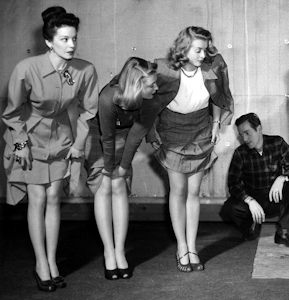
women walking around in short skirts and high heels and
they’re just WHORES!” Whoa. Okay,
let’s
back up here. And, unlike our gracious hosts at the
Of course, there’s something women can do about this, if you want: start making fun of guys who aren’t in flawless physical condition. Start talking about how gross they are at top volume 24/7, and never sleep with any guy who isn’t hot. After all, if you’re still going to fuck them, there’s no reason for them to change. In
ancient |
read more awesome 1585 essays.
like and follow The 1585 on Facebook.
